
Enterprise Magento to Shopify Migration
WHY BRANDS LEAVE MAGENTO FOR SHOPIFY PLUS
REDUCE TCO
Stop draining your IT budget on server maintenance and security patches. Reallocate resources from "keeping the lights on" to revenue-generating initiatives.
ELIMINATE RISK
Move from a vulnerable self-hosted environment to Shopify’s Level 1 PCI-compliant cloud. Mitigate the risk of data breaches and constant security audits.
SCALE FREELY
Legacy architectures struggle with high concurrency. Shopify Plus handles over 10,000 transactions per minute, ensuring stability during Black Friday.
MARKETING AGILITY
Remove developer dependency for simple site changes. Empower your marketing team to launch landing pages and campaigns in hours, not weeks.
GRANULAR DATA MIGRATION
We execute a comprehensive transfer of historical data including orders, customers, passwords, and reward points. We ensure zero corruption or data loss during the transition.
SEO & URL PRESERVATION
Protect your organic search authority. We crawl your existing site to map every URL and implement precise 301 redirects to maintain your keyword rankings.
ERP SYSTEM INTEGRATION
We connect your back-office. Whether you use NetSuite, Sage, or Microsoft Dynamics, we ensure seamless ERP integration for automated inventory and fulfillment.
ENTERPRISE B2B RE-PLATFORMING
We replicate and enhance complex B2B logic—including wholesale pricing tiers, net payment terms, and custom catalogs—utilizing Shopify’s native B2B suite.
UX/UI & FRONTEND DESIGN
We don't just port legacy designs. We perform a UX/UI design audit to modernize your customer journey and optimize for mobile-first conversion.
ARCHITECTURE STRATEGY
Every migration begins with strategic eCommerce consulting to audit your tech stack and define the optimal roadmap for long-term scalability.
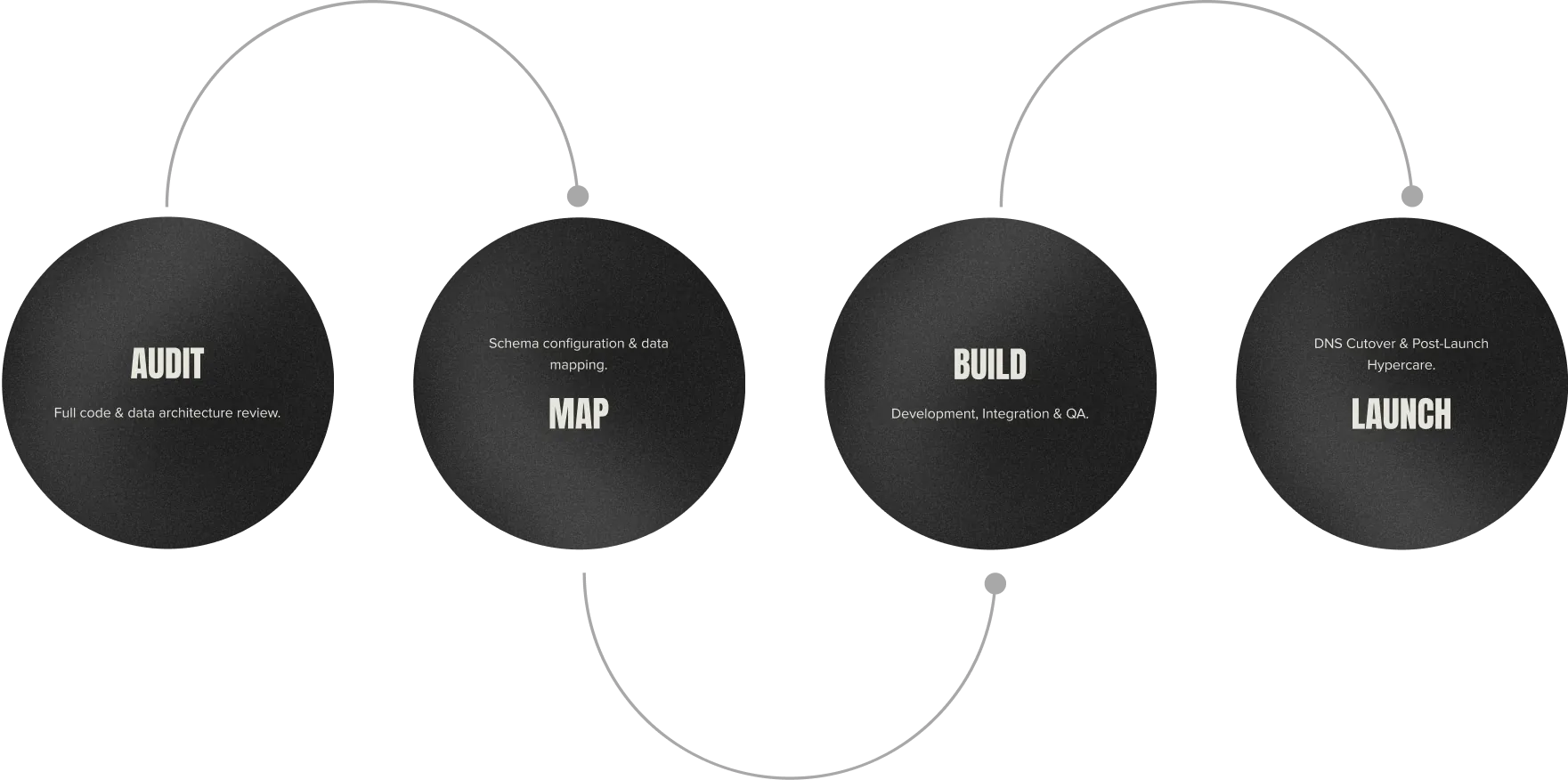
THE ZERO-RISK MIGRATION PROTOCOL
WHY ENTERPRISES TRUST IWD
Unlike Shopify-only agencies, we are Adobe Commerce experts. We understand the complex SQL structure of the database you are leaving, ensuring a flawless translation.
We do not outsource your data to offshore farms. Your migration is handled by our in-house technical leads to ensure security, quality, and communication.
We utilize custom-built scripts and connectors to automate complex data transfers, reducing human error and accelerating timelines.
We combine technical backend excellence with high-converting frontend experiences, ensuring your new site is not just faster, but more profitable.
MIGRATION ROI IMPACT
READY TO LEAVE LEGACY TECH BEHIND?
Telling their story like it's our own
COMMON QUESTIONS FOR OUR ECOMMERCE WEB DESIGN AGENCY
Magento to Shopify migration: what actually moves and how we protect rankings
A Magento to Shopify replatform is rarely a single import. Catalog, customer accounts, order history, content URLs, theme behaviour, custom modules, and ERP integrations all migrate on different timelines and with different risk profiles. The work below is what our team scopes out on day one of every Magento → Shopify engagement.
What we migrate and how
Our 5-phase Magento to Shopify migration framework
1. Discovery and gap analysis
Audit current Magento store: traffic-bearing URLs, custom module dependencies, B2B configurations, ERP/PIM integrations. Output is a migration scope document with phased risk areas and a recommended Shopify SKU (Shopify, Advanced, or Shopify Plus).
2. Theme rebuild on Shopify
Recreate the storefront design on a Shopify Online Store 2.0 theme (Dawn-based or custom). We don't 1:1 copy your Magento theme. We audit conversion patterns first and rebuild for Shopify's section/block model.
3. Data + URL migration
Matrixify or Bulk API for products, collections, customers, pages, blog content. We build the 301 redirect map in parallel: every traffic-bearing legacy URL maps to a Shopify equivalent before cutover.
4. Apps + integrations
Replace Magento module functionality with Shopify-native equivalents. Common swaps: Amasty → Shopify Search & Discovery, Aheadworks B2B → Shopify B2B, custom checkout → Shopify Functions + Checkout UI Extensions.
5. QA, cutover, and SEO monitoring
Staging UAT on a *.myshopify.com domain, then DNS cutover, then 8-week SEO monitoring against the pre-cutover baseline. Expected curve: -5% to -10% organic weeks 2-4, baseline by week 8, +5% to +15% by week 12.
Outcomes our clients see
Metrics from IWD-led migrations 2024-2026. Outcomes vary by source catalog depth and incoming link profile.